
Buyer’s guide · 8 min
How to choose a hyperbaric chamber.
Almost every chamber on the market will pressurise and almost every brochure will say the same things. These are the nine questions that actually separate them — and the answers you should insist on in writing before you sign anything.
By Hagen Thiers · updated 21 September 2026
What pressure does it actually reach?
Pressure is quoted in ATA — atmospheres absolute, where 1 ATA is the pressure at sea level. A chamber rated to 2 ATA doubles it. The distinction that matters commercially is between soft, inflatable chambers, which typically stop around 1.3–1.5 ATA, and rigid steel or acrylic chambers, which are built for 2 ATA and above.
Do not accept a figure on its own. Ask for the maximum working pressure, the certified design pressure, and whether the quoted maximum is available in your market. In the European Union a chamber placed on the market for a medical purpose is a medical device, so the same hardware is sometimes offered in a medical and a non-medical specification. OxyHelp, for example, describes a CE Class IIb medical-device route for the software that raises its chambers to 2 ATA, and sells the OXYLIFE I as a non-medical device.
Who certified the pressure vessel, and to what?
A chamber is a pressure vessel with a person inside it. The most widely referenced standard is ASME PVHO-1, Safety Standard for Pressure Vessels for Human Occupancy — current edition 2023 — which sets requirements for design, fabrication, inspection, testing and marking of any vessel enclosing a human above a 2 psi differential, hyperbaric chambers explicitly included.
In the European Union a chamber must also satisfy the Pressure Equipment Directive 2014/68/EU, which governs CE marking for pressure equipment, and — where it is placed on the market for a medical purpose — the Medical Device Regulation. Ask which standard the vessel was built to, which notified body or laboratory tested it, and to see the report. Non-destructive testing (X-ray, ultrasound, dye penetrant) on welds is normal practice and the results exist on paper.
How does the oxygen actually reach you?
A chamber pressurises with air; the oxygen is delivered separately. The three common routes are a mask, a hood, or a concentrator feeding the cabin. Each has consequences you live with daily: masks are the cheapest and the least comfortable over 60 minutes, hoods are better tolerated, cabin enrichment is the most comfortable and the most demanding on ventilation and fire precautions.
Ask what concentrator is included, its output in litres per minute, whether it is in the price, and where it physically stands. On the Lifetech line the compressors and oxygen generators are included and sit in a separate technical room.
How many people, really?
Seat count is the single largest driver of price and of the room you need. One seat is a capsule you can put in a dressing room; two seats is a room of its own; four to six seats is a facility. In the range we advise on, the OXYLIFE I80 and I90 are single-place; the OXYLIFE C2 to C5 run from one to six seats; the Lifetech line runs from the single-seat C1 Extended to the C6.
Buy for the second year, not the first. A household that buys a one-seater almost always wants two seats within eighteen months, and a chamber cannot be extended.
The full range, with capacities and published prices: OXYLIFE I80 to C5 and the Lifetech line.
What does the building have to do?
This is where most private projects stall. A 5Lifetech C3 needs a room of at least 5 × 4 m for a chamber that stands on 3 × 2 m, modules of 196 cm diameter and about 100 kg through the access route, five dedicated electrical circuits at 230 V, and a separate technical room with at least 500 m³/h of fresh air, 28,000 BTU of cooling and an ambient temperature below 28 °C.
Get this assessed on your own floor plans before you choose a model, not after. We include the assessment in the price for exactly that reason.
How loud is it, and where does the noise go?
Compressors, oxygen concentrators and chillers are not quiet, and in a private house they are the complaint that arrives three months after delivery. The answer is almost always the same: put them in a technical room away from the chamber, on isolating mounts, with ducted air. Ask for the sound pressure figure of the plant, not of the cabin.
What is in the price — and what is not?
Compare quotations line by line. Delivery, rigging into the room, installation, commissioning, the compressor, the oxygen generators, the chiller, training, treatment protocols and the first service are all items that appear in one quotation and quietly vanish from another.
On the Lifetech line our published price includes the location assessment, physical material samples, a 2D or 3D render of your chamber in your actual room, exterior and interior specification, delivery, installation, compressors and oxygen generators, training and protocols, and a five-year warranty.
Who services it, and how fast?
A chamber is serviced equipment, not furniture. Ask for the service interval, the consumables and their annual cost, the response commitment, and — most usefully — the name of the nearest engineer. For the OXYLIFE range OxyHelp states a two-year manufacturer warranty with an option to extend to three, and service within ten working days worldwide. The Lifetech line carries five years.
Where do the prices come from?
Ask any advisor where their number comes from. Ours are the manufacturers’ published figures and our published price list, in euro, excluding VAT, duties and site works. Where two published sources disagree — and they do — we print both and mark the figure “to confirm” rather than choose the one that suits us.
Sources
- ASME PVHO-1, Safety Standard for Pressure Vessels for Human Occupancy
- Pressure Equipment Directive 2014/68/EU
- OxyHelp — manufacturer statements and specifications
Prices and specifications are the manufacturers’ published figures, excluding VAT, duties and site works. Nothing on this page is medical advice.
Keep reading
More guides.
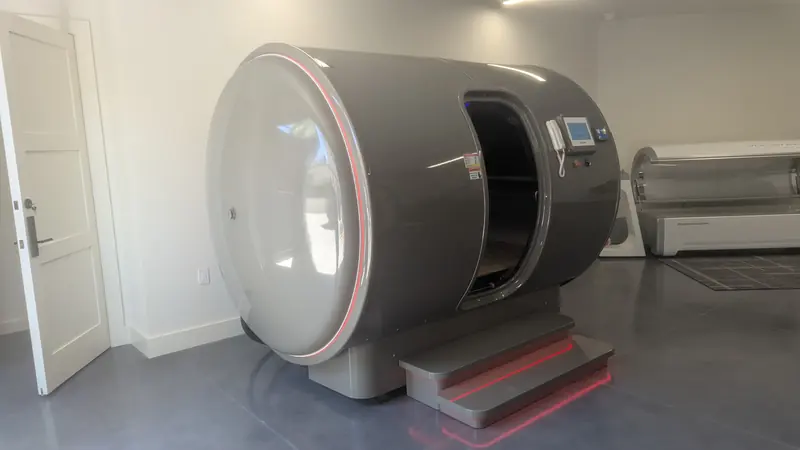 Explainer · 5 minATA, bar and PSI: hyperbaric pressure explainedWhat ATA means, how 1.3, 1.5 and 2.0 ATA differ, why pressure alone does not describe a chamber, and where the regulatory line falls in Europe.Read
  Buyer’s guide · 6 minWhat a hyperbaric chamber really costs to ownBeyond the purchase price: site works, power, servicing, consumables, insurance and the cost lines that only appear after delivery.Read
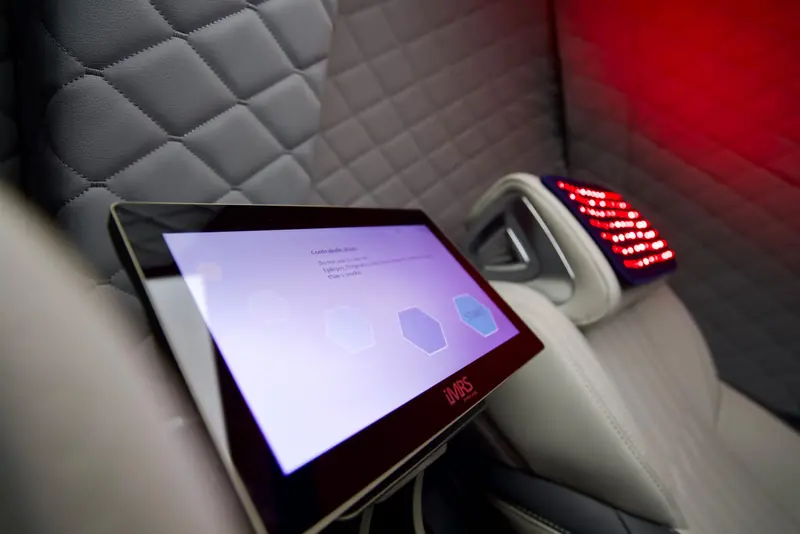
 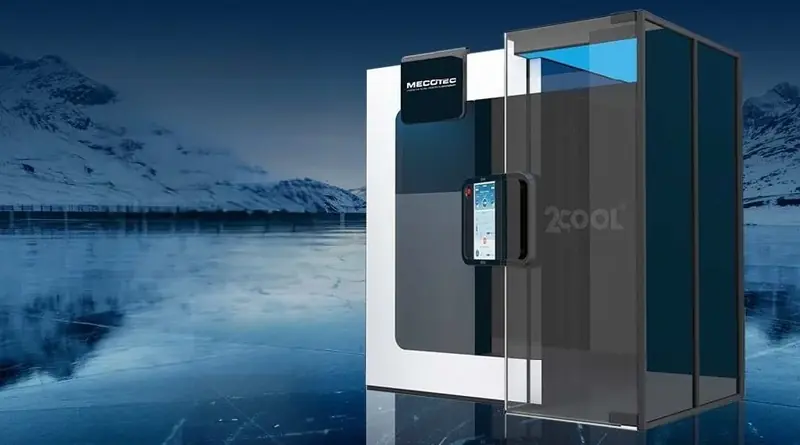 Buyer’s guide · 6 minHBOT, red light, cryotherapy or PEMF — which to installAn honest comparison of hyperbaric oxygen, red and near-infrared light, cryotherapy and PEMF: what a session is, what each needs from a building, and what each costs.Read